


★★★★★
Reopen The Lever, Rework The Connection
You can release and reconnect the wire by reopening its lever. Useful when your LED lighting layout needs another adjustment.
Product description
Couldn't load pickup availability

High Quality and Safe: Improved internal design, using thickened copper conductor strips for better tightness and conductivity. The electrical wire connector housing is made of high-quality PC insulation material. It has the advantages of long service life, corrosion resistance, high temperature resistance, aging resistance.

Practical Design: The lever wire connector is an innovative reusable connector, the wire can be detached or reconnected many times easily. Also adopting special scientific design to save space. When you splice wires, you don't have to worry about twists between wires and can better manage different wires separately.

Easy to Use: Compared to traditional wire twist nuts and wire tape, our lever nuts are easier to use. Just pull the small lever to 90°, peel off about 0.4 inches of the wire coating, insert the wiring hole to the end, and press the lever. Greatly save your valuable time and energy, making your electrical projects a breeze.

Broad Compatibility: Can be used with solid, stranded and flexible wires. Applicable wire diameter 0.1~4mm² / 28-12AWG. The connector is widely used in decorative wiring, electrical projects. Such as ceiling lights, spotlights, LED strip light, power supply, electrical boxes, loudspeakers, etc.

Convenient Inspection: There are test holes on the back of the electric connector. The test hole can be used to check whether the wire is carrying power. It facilitates you to quickly troubleshoot circuit problems and saves you time.


Your arms are up, the ceiling light is waiting, and you're still wrestling wires into a twist nut. That's a poor use of your Saturday. These lever connectors let you clamp each stripped wire into its own port instead of winding conductors together and reaching for more tape.
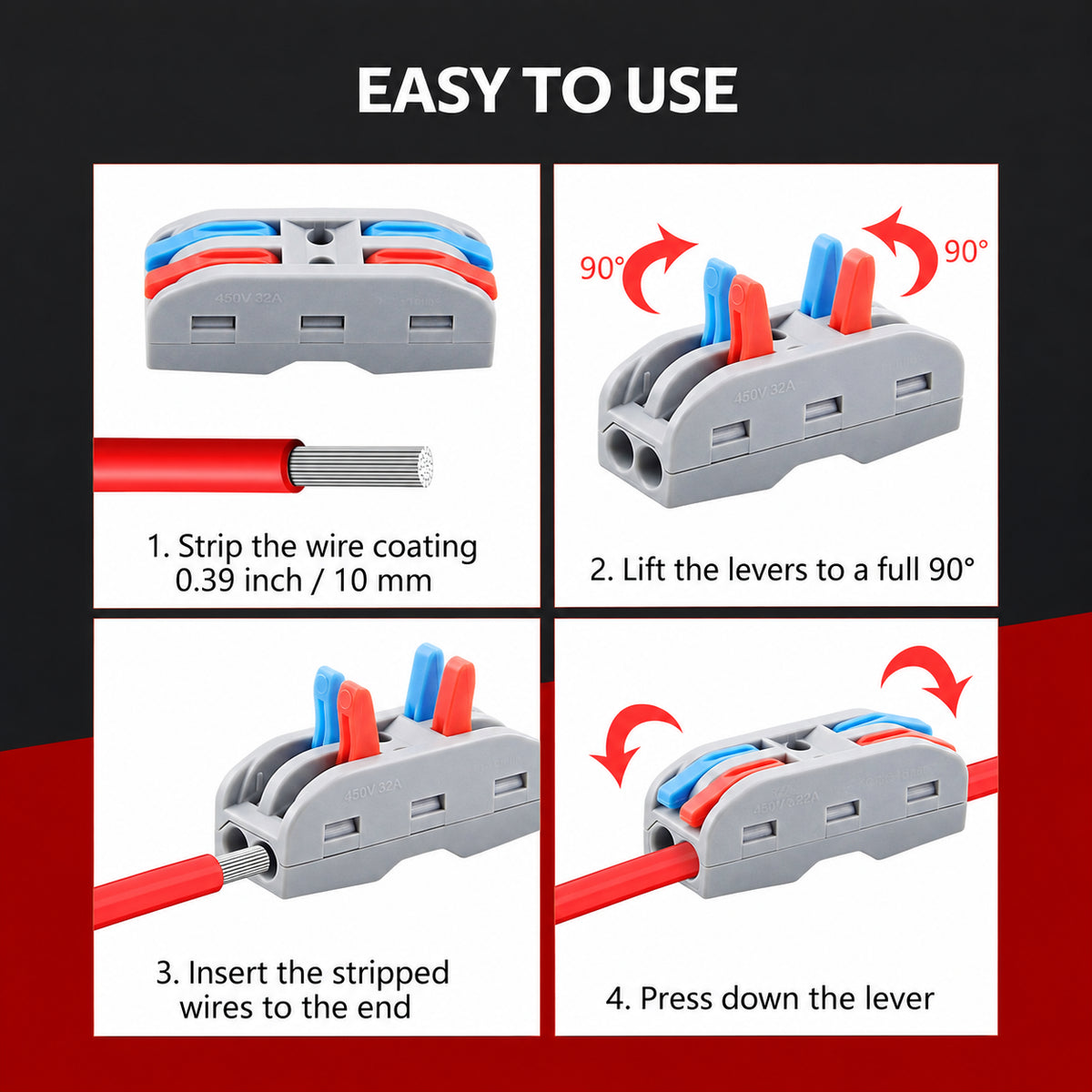
Start with power disconnected and verified off. Strip about 0.4 inches of insulation, raise the lever to 90°, insert the wire fully, then press the lever down. That solid lever snap replaces the fiddly twisting step, so you can get on with your lighting project.
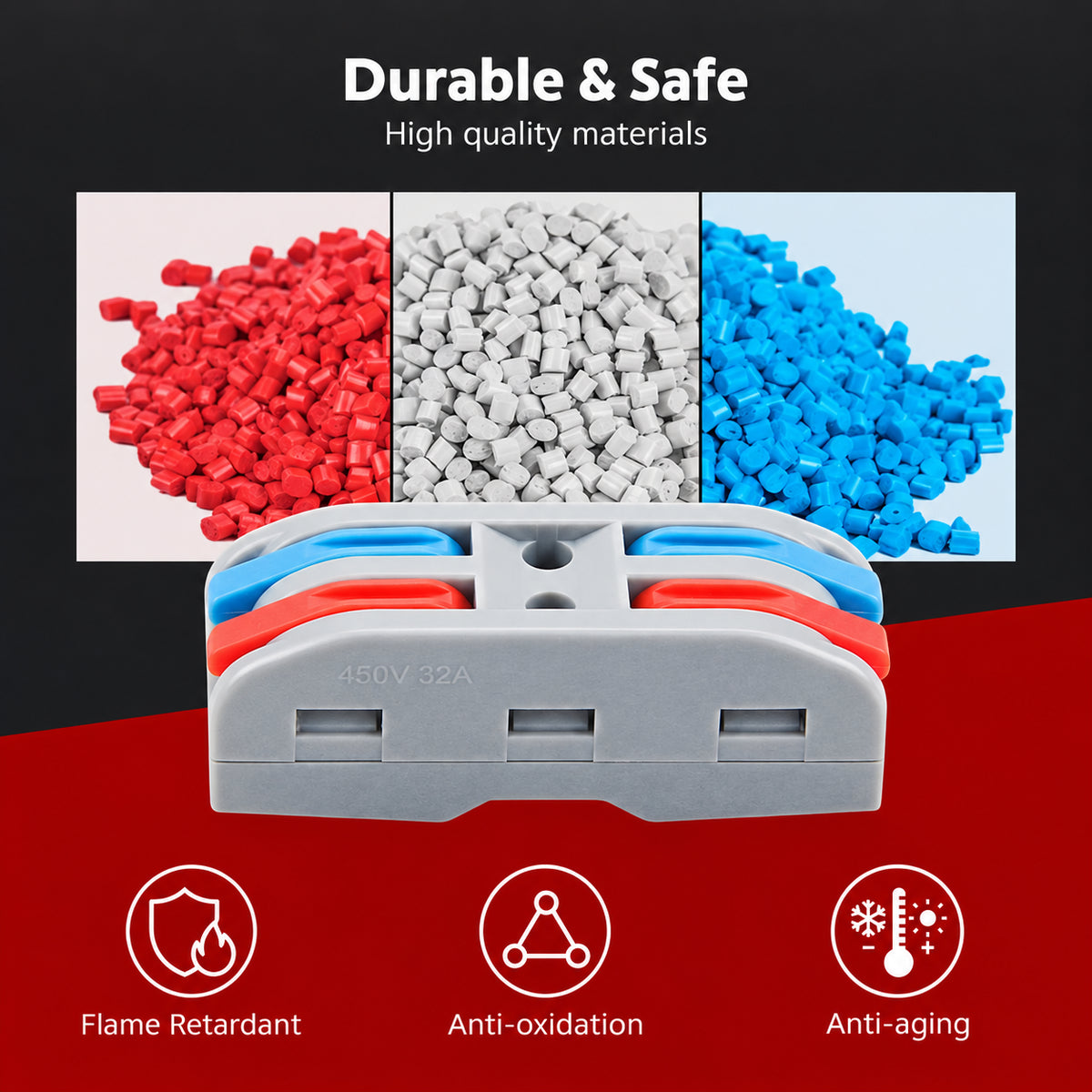
You're the person who lines up the tools before starting and takes pride in what sits behind the cover. The compact 2-in, 2-out layout gives your wires separate entry points. Red and blue levers keep those connection points visually distinct—a small detail that suits the way you work.

Inside, thickened copper strips grip the wire with enough tension to resist vibration and movement. That tight, mechanical hold eliminates the slow creep-loose that plagues twisted connections. Once you press the lever down, the wire isn't going anywhere—so you can finish your project instead of redoing loose connections later.

You shouldn't have to dismantle a connection just to reach a test point. Rear test holes provide inspection access without removing the wires. Changing your LED layout later? Disconnect power and verify it is off, then reopen the lever to release and reconnect the wire.

This 10-pack outlasts any one-time project. LED retrofit, junction box cleanup, automotive rewire—reopen the lever and reconfigure for the next job. You're building a toolkit that stays organized and ready, not accumulating dead wire nuts and tape in a drawer.
Compared with twist-and-tape connections, you get individual lever clamps, separate entry ports and built-in test access. Make the connection without winding wires together.
| christsgifts.com | Twist-and-tape | |
|---|---|---|
| Skip twisting wires together |
✓
|
✕
|
| Rework connections with reusable levers |
✓
|
✕
|
| Keep wires in separate entry ports |
✓
|
✕
|
| Distinguish connections with colored levers |
✓
|
✕
|
| Inspect through integrated test holes |
✓
|
✕
|
| Connect through thickened copper strips |
✓
|
✕
|
You can release and reconnect the wire by reopening its lever. Useful when your LED lighting layout needs another adjustment.
You can see the red and blue levers against the gray housing, with separate entry ports that keep the connection layout orderly.
Rear test holes give you access for circuit inspection without pulling the wires out of their clamps.
The pictured guide lists solid and stranded wire at 28–12 AWG, and flexible wire at 28–14 AWG. Follow the range for your wire type rather than assuming every wire fits the full range.
Yes. The lever mechanism lets you release and reconnect a wire instead of discarding the connector after one use. Make adjustments only with power disconnected and verified off.
No. Rear test holes provide inspection access without removing the wires. Use appropriate test equipment and safe electrical practices; test access does not make an energized circuit safe to touch.
You get 10 reusable lever-type connectors in the 2-in, 2-out configuration. Each has a compact PC housing, red and blue operating levers, and integrated test holes.


